
Start a project

AI strategy, integration & automation Put AI into production, not another disconnected demo.

We identify high-value use cases, evaluate the right model and delivery pattern, then integrate AI into the systems where work already happens. Bring your own model keys, use managed inference or deploy into controlled infrastructure.

Enterprise delivery · Senior specialists · UK & Türkiye
AI strategy, integration & automation by Dika Design
02 · When teams call us

Signs it is time to change the system.

Pilots that never reach production

Impressive demos stall when they meet real data, permissions and edge cases.

Staff paste data into public chat tools

Useful shortcuts become a data protection problem without a safe alternative.

Nobody can say what AI costs

Usage grows across teams and providers with no view of spend per task.

Answers you cannot trust

Output sounds right but cannot be checked against your own sources.

Document work that eats days

People read, copy and re-type information that a system could extract.

Locked into one provider

Prices, quality and terms change, and switching means rebuilding.

03 · Our approach

AI systems designed for real operations

  1. Use case before modelWe choose architecture from the business task, required quality, latency, privacy and cost constraints.
  2. Human control where it mattersApproval, escalation and traceability are designed into workflows rather than added after launch.
  3. Provider flexibilityAvoid unnecessary lock-in through model routing, bring-your-own-key support and deployment choices.
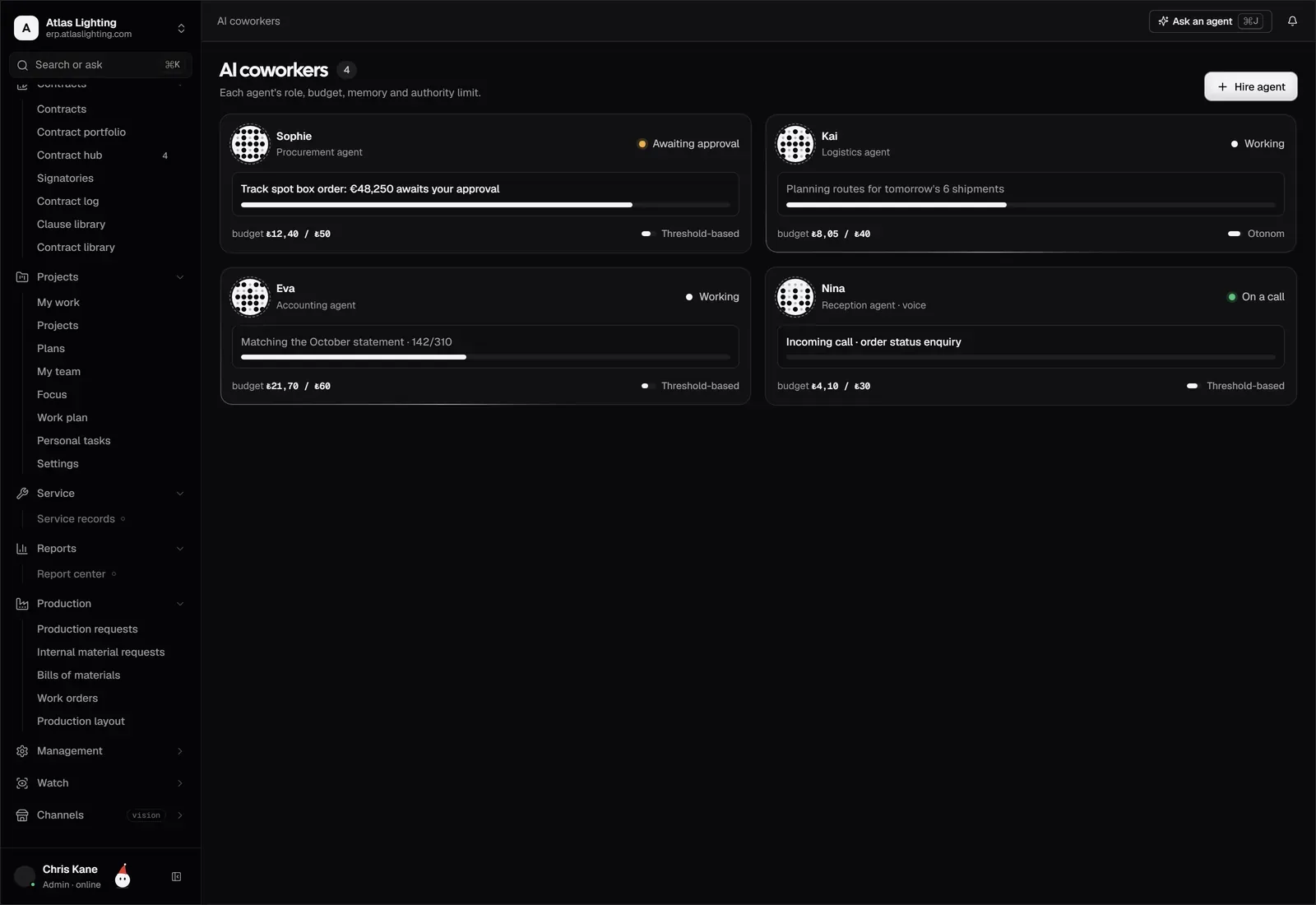
AI coworkers with budgets and approval limits in Dika Ops
Built the same way · AI coworkers in Dika Ops
04 · Capabilities

Sixteen capabilities. One accountable team.

Everything we design, build and run in AI & automation, delivered by the same senior team.

  • 01

    AI readiness assessment

    A review of processes, data access and risk to find where AI is worth applying.

  • 02

    Model evaluation and routing

    Testing models against your own tasks and sending each request to the best fit.

  • 03

    AI agents and copilots

    Assistants that draft, check and route work inside the tools your teams use.

  • 04

    Retrieval-augmented generation

    Answers grounded in your own documents and records, with sources shown.

  • 05

    Multimodal AI workflows

    Text, image, video and speech models combined in one governed process.

  • 06

    Document and knowledge automation

    Reading, classifying and extracting data from contracts, invoices and forms.

  • 07

    Human-in-the-loop review

    Approval steps placed where a person must confirm before the system acts.

  • 08

    Bring-your-own-key integration

    Use your own provider accounts, with credentials kept on the server.

  • 09

    Managed inference integration

    Hosted model access with usage limits, fallbacks and cost tracking.

  • 10

    Private and self-hosted deployment

    Orchestration and, where feasible, models running on infrastructure you control.

  • 11

    Prompt and workflow versioning

    Every change to prompts and steps tracked, tested and reversible.

  • 12

    Quality evaluation

    Test sets and scorecards that measure output before and after each change.

  • 13

    Cost and latency optimisation

    Caching, routing and model choice tuned to keep spend and response time in check.

  • 14

    Monitoring and audit trails

    A record of inputs, outputs, approvals and costs for every run.

  • 15

    API and product integration

    AI features delivered inside your product or internal systems, not beside them.

  • 16

    AI governance foundations

    Usage policies, risk levels and responsibilities that people can follow.

05 · How an engagement runs

Five steps, visible at every stage.

  1. 01Use-case discoveryWorkflows ranked by value, feasibility, data access and risk.
  2. 02Data and risk reviewWhat the system may read, store and do, and where a person must approve.
  3. 03Prototype with evaluationA working version measured against a test set built from your own cases.
  4. 04Production integrationPermissions, approvals, logging and cost limits inside your real systems.
  5. 05Monitor and improveQuality, cost and latency reviewed as models and usage change.
06 · What you receive

Deliverables you keep, not just a launch.

Every engagement ends with assets your organisation owns and can run without us.

Plan the first phase
  • Prioritised use-case list

    Opportunities with value, effort, risk and running cost side by side.

  • Architecture and model plan

    Context, routing, hosting and fallback choices explained.

  • Evaluation set and scorecard

    Test cases from your work and the measures used to accept a release.

  • Production integration

    The AI workflow running inside the systems where work already happens.

  • Approval and audit design

    Who approves what, and a record of every decision the system supports.

  • Cost and quality reporting

    Spend, volume and quality per workflow, visible to the owners.

07 · Who it is for

Built for organisations like yours.

Document-heavy operations

Finance, procurement, legal and back-office teams handling large volumes of paperwork.

Customer service and sales teams

Teams answering repeat questions and preparing quotes and replies.

Product companies adding AI

Software teams that need AI features their customers can rely on.

Privacy-sensitive organisations

Businesses that must keep data, keys and models under their own control.

Where AI pays off first

The best first projects are frequent, slow and well understood: reading documents, drafting replies, classifying requests or preparing comparisons. They have clear inputs, a known good result and a person who can review the output.

We start there because the value is easy to measure, and because the controls you build for the first workflow are reused for the next ones.

Choosing models without lock-in

No single model is best at everything, and prices and quality change often. We design a routing layer so each task can use the model that fits its quality, speed and cost needs, and so a provider can be replaced without rebuilding the workflow.

Where data must stay inside your organisation, orchestration and, where feasible, the models themselves can run on infrastructure you control.

Keeping people in control

Every AI workflow gets explicit limits: what it may read, what it may change, and which actions need approval. Above those limits the system prepares the work and a person decides.

All runs are logged with inputs, outputs, approvals and cost, so you can review what happened and improve the process.

Measuring quality and cost

We build a test set from your own cases before launch and score every change against it. In production we track quality, cost and latency per workflow, so decisions about models and prompts are based on evidence rather than impressions.


FAQ

AI & automation, answered.

Clear answers before discovery, scoping and delivery begin.

Ask a different question
Where should an organisation start with AI?

Start with a costly or slow workflow that has clear inputs, outputs and reviewers. We assess value, data readiness and risk before selecting a model or architecture.

Do you work with different AI providers?

Yes. We can integrate commercial and open models and design routing so the system can select providers by capability, quality, latency or cost.

Can we use our own API keys?

Yes. Bring-your-own-key is supported where appropriate, and server-side handling keeps provider credentials away from browser clients.

Can AI systems run on our infrastructure?

Yes. Depending on model and hardware requirements, application and orchestration layers can run on customer-controlled infrastructure, with self-hosted models where feasible.

How do you reduce unreliable AI output?

We combine constrained workflows, trusted context, structured output, validation, evaluation datasets, monitoring and human review according to the risk of the task.

Can you automate image, video and content production?

Yes. Dika Studio provides a practical product foundation for editable, collaborative visual workflows, while custom integrations can connect those capabilities to wider business systems.

Do you provide ongoing optimisation?

Yes. AI systems require continuous evaluation of quality, cost, latency and model changes. We can operate that improvement cycle with your team.

Will AI replace our staff?

Our work focuses on removing repetitive steps so people spend their time on judgement, customers and exceptions. Approval stays with your team wherever the risk calls for it.

How do you protect confidential data?

We limit what each workflow can access, keep credentials on the server, log every run and, where needed, keep processing on infrastructure you control.

What is a sensible first step?

A focused prototype on one workflow with a clear owner and test cases. It shows value, cost and risk before any wider rollout.

Move from AI experiments to a system people use.

We will help you choose the right first use case, define control points and build a production path that matches your organisation.

  • Provider-neutral architecture
  • Quality, cost and latency measured together
  • Human review and deployment control